
Aesthetic Realms
A Navigational Architecture for the Living Web
Abstract
Aesthetic Realms is a framework that reveals the energetic interplay between digital infrastructure and living culture. By interpreting socio-technical systems through aesthetic dimensions such as mythic, relational, temporal, and somatic, it reveals how coherence emerges when technological and cultural layers align. The framework cultivates a reproducible practice for designing authenticity and societal fit across next-generation digital ecosystems.
1 Introduction
Across Web3 and AI, brilliant projects often fail for reasons beyond technology. Teams lose alignment, communities drift apart, and promising ideas dissolve despite ample funding and technical skill. The causes are rarely visible in data or design documents; they emerge in how people relate, how meaning moves through a network, and how attention is shaped or lost.
This is the unseen layer that shapes all socio-technical systems: culture. When culture and infrastructure move out of sync, networks fragment, trust erodes, and behaviour begins to imitate rather than originate. Much of today’s digital landscape is caught in this pattern, simulating aliveness while severed from its source.
Aesthetic Realms was developed to address this gap. It translates the hidden dynamics between technology and culture into a practical language for alignment. Within this framework, imitation refers to copying forms or behaviours without understanding or grounding them in context; authenticity is when cultural and technological layers align in shared purpose and integrity; coherence emerges when that alignment moves through people, processes, and technologies.
The study of these dynamics forms the foundation of Web Energetics, a new discipline dedicated to understanding how culture and technology shape one another. It offers a way to perceive what truly moves through a project beyond code and surface-level metrics.
2 Architecture Overview
Born from nine years of field practice across Web3, AI, and socio-technical projects, Aesthetic Realms distills patterns observed in real teams, communities, and networks. Informed by complex systems thinking and adjacent fields such as human–computer interaction, organisational design, and cultural ethnography, it traces how subtle shifts in behaviour reveal deeper changes in collective intelligence.
To make the energetic relationship between culture and technology legible, Aesthetic Realms maps systems across eight aesthetic dimensions. Each axis captures a dynamic of tension and balance that shapes integrity within digital ecosystems.
Table 1: Aesthetic Realms Research Axes
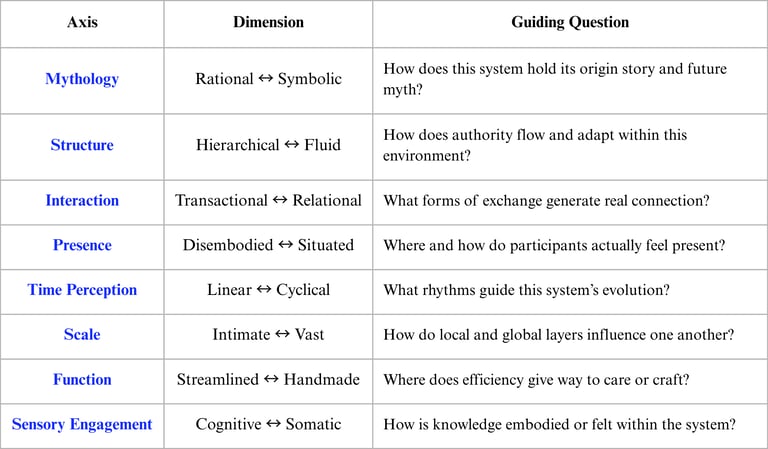
Drawing from Erin Meyer’s Culture Map [1], which decodes the hidden dimensions of cultural difference, and Christopher Alexander’s Pattern Language [2], which translates lived experience into design patterns, the axes reimagine these lenses for the digital frontier.
Mythology — holds the stories that give systems meaning; when logic severs from myth, purpose fades.
Structure — governs how authority and adaptability circulate, revealing whether control supports or constrains flow.
Interaction — exposes how trust forms through exchange; whether value is transacted or truly shared.
Presence — grounds participation, ensuring that digital experience remains embodied and situated.
Time Perception — shapes rhythm and renewal, aligning technological pace with human cycles.
Scale — measures proportion, balancing intimacy with reach.
Function — reflects the relationship between efficiency and care, between the frictionless and the crafted.
Sensory Engagement — (the emerging frontier), bridges cognition and sensation, reminding us that intelligence is felt as well as known.
Together, these influences shape a methodology for reading digital ecosystems as living environments, revealing how coherence arises or drifts apart across networks.
2.1 Methodology
The Aesthetic Realms methodology translates the axes into practice, guiding observation, interpretation, and adaptation across complex socio-technical systems. Each project is treated as a living network of interdependent layers, from team dynamics and governance rhythms to community rituals, interfaces, and flows of value.
The framework unfolds in three iterative phases:
1 Immersive Reconnaissance — Direct participation and observation in a project’s physical and digital environments. This involves studying communication, decision-making, and collective energy alongside technological structures to identify where coherence or dissonance arises.
2 Cultural Synthesis and Aesthetic Shaping — Insights are synthesised through the Aesthetic Realms axes to identify tension and alignment. Interventions harmonise culture and technology, producing narratives, design identities, and practices that anchor the project in authenticity and shared purpose.
3 Cultural Impact Measurement — Cultural indicators and resonance patterns such as engagement, trust, participation, and tone, are tracked over time. This feedback loop measures coherence and guides ongoing adaptation.
The methodology brings together the sensing process, the interpretive layer, and the adaptive feedback cycle that sustain culture within technology. It reveals how energy moves through a project’s ecosystem and how meaning flows across digital and physical spaces. Through this process, Aesthetic Realms aligns technology with the subtleties of human experience, cultivating contextual intelligence; the capacity of systems to sense and adapt to the rhythms of their social and aesthetic environment.
4 Conclusion
The web is alive, yet we still move through it with tools inherited from an industrial era. The internet amplifies human energy in ways we barely comprehend, leaving people unsettled and depleted. And yet we keep building; inspired by Bitcoin’s architecture [3] and a wave of socio-technical experiments, Web3 reveals patterns that hint at networks capable of sustaining themselves. These signals suggest a web that can be ecological and self-organising, but only if culture evolves alongside it.
Aesthetic Realms is founded on the principle that human behaviour is shaped more by unseen forces than by what we consciously express, echoing Jung’s insight [4] that the unconscious drives patterns both individual and collective. When these invisible dynamics are made visible and integrated into design, systems can regain coherence. Coherence evolves alignment into wholeness, allowing culture and technology to interweave and nourish one another as a living system.
The framework serves as both compass and toolkit for coherence, ethical resonance, and societal fit. It lays the groundwork for Web Energetics, a discipline for observing and guiding the interplay of culture and technology, and for cultivating the social intelligence that will carry us into the emerging web.
5 References
[1] Erin Meyer. The Culture Map: Breaking Through the Invisible Boundaries of Global Business. PublicAffairs, 2014. https://erinmeyer.com/books/the-culture-map
[2] Christopher Alexander, Sara Ishikawa, and Murray Silverstein. A Pattern Language: Towns, Buildings, Construction. Oxford University Press, 1977. https://en.wikipedia.org/wiki/A_Pattern_Language
[3] Satoshi Nakamoto. Bitcoin: A Peer-to-Peer Electronic Cash System. 2008. https://bitcoin.org/bitcoin.pdf
[4] C.G. Jung. The Archetypes and the Collective Unconscious. Princeton University Press, 1981.
© 2026 Dayvan Studios. Build with care.


3 Key Applications
The following applications translate the philosophy of Aesthetic Realms into practical design intelligence for teams, organisations, and networks. They demonstrate how coherence can be cultivated within socio-technical environments.
Human-Driven Ecosystem Analysis — Reveal invisible dynamics that shape behaviour and predict friction before it manifests.
Systemic Experience Design — Craft digital environments that feel alive to their participants and where tools and narratives co-evolve with purpose.
AI and Agent Alignment — Guide intelligent systems to reflect human values, ethics, and cultural nuance.
Community and Governance Architecture — Design for interactions that nurture trust, coherence, and shared meaning.
Research and Education — Advance the emerging discipline of Web Energetics, expanding the cultural vocabulary of technology.
Together, these applications form a living practice that restores coherence between the human and the technical. They invite a shift from designing for efficiency to designing for resonance; where systems learn to reflect the depth, rhythm, and intelligence of the cultures they serve.
"I wish I could show you, when you are lonely or in darkness, the astonishing light of your own being."
— Hafez